| The Problem With Environmental Justice | |
 |
|
|
This History of the Social Justice Movement: In the distant past, there were enormous injustices between people of different ethnicities, genders, religions, and sexual orientations. Over time, more and more of these injustices were addressed, and the world became increasingly fair. A great deal of worthwhile progress took place in the United States in the 1960s. But one unfortunate idea also emerged: the social justice movement convinced much of the rest of society that "bigots" should not enjoy the normal protections of free speech. In fact, "bigots" could be punished by almost any means available until they shut up. Since the development of social media, this has become even worse. Social justice advocates learned to weaponize social media so that if someone said anything they didn't like, a social-media mob of thousands of people could be mobilized to bombard the HR or DEI departments of the offender's employer with angry messages, attempting to cost that person his or her livelihood. Meanwhile, the definition of "bigot" has expanded beyond all recognition. Originally, you had to actively dislike a group of people to be considered a bigot. Now, the term is routinely applied to anyone who disagrees with the worldview of social justice advocates in any way—including, for example, a parent who does not want his or her 15-year-old daughter's breasts surgically removed. Among social justice advocates, there are so many rules governing what may be said, to whom, by whom, and about whom that the entire conversation becomes completely and utterly divorced from reality and is basically not worth having. When you're trying to have a serious discussion and someone drags social justice into it, the IQ of the debate seems to drop by at least 90 points, as social justice advocates begin accusing anyone who disagrees with them about anything of being a "bigot." The political right has largely rejected the social justice worldview, mobilizing behind Donald Trump, who routinely says flagrantly bigoted things. To many of his supporters, that is part of the point: it signals his contempt for social justice ideology. And half the voters in the country love it. The environmental movement, however, is overwhelmingly liberal, and liberals are generally willing to abide by the speech rules demanded by the social justice movement. One of the most important of those rules seems to be that the social justice movement itself is never, ever to be criticized for any reason. When something may not be criticized, it eventually becomes sacred and holy. Among many liberals, social justice has consequently come to be regarded as the noblest and most urgent cause in the history of the human race. Among liberals, if someone is accused of "bigotry" against group X, there is often no effective defense.
So instead of the rule being "Don't be a bigot," the practical rule becomes: "Don't even be accused of being a bigot, no matter how frivolous the accusation." For a liberal whose friends and professional circle are overwhelmingly liberal, being smeared as a "bigot," however frivolously, can mean losing all of one's friends, losing one's career—even, in extreme cases, facing total ruin. What this means is that, in a conversation among liberals, a sufficiently aggressive social justice activist can often get anything they want. The moment they encounter resistance, they can accuse the people resisting them of being "bigots"—an accusation for which there may be no socially acceptable defense. And what social justice activists often want is to talk about social justice all day long and forget about everything else. Social justice activists have increasingly sought to incorporate their agenda into the environmental movement, under the banner of Environmental Justice. Two arguments are commonly used to establish the relevance of social justice to environmentalism:
Those two arguments are usually more than enough to convince liberals in the environmental movement that talking about social justice is a great idea. The problem is that once liberals start talking about social justice, they never finish. Eventually, they risk forgetting about saving the planet altogether. Sometimes liberals say things like, "Minorities are the people most severely affected by climate change, so they should lead the movement." This is nuts. That is like saying that the American Cancer Society should let dying, terminally ill cancer patients in hospice care decide which research projects to fund rather than relying on qualified doctors and scientists who actually know something about biology. The people who suffer most from a problem deserve concern, compassion, and a voice. But suffering from a problem does not automatically imply expertise in solving it. None of this is to say that there have been no historical injustices committed against particular demographic groups. There have been enormous injustices, and where their consequences persist, something should be done about them. What I am saying is something much narrower—and, I believe, extremely important:
|
|
|
There was an Environmental Justice advocate in the Sierra Club, Aaron Mair, and they even made him president of the organization. Watch the following exchange where Ted Cruz goads him into having a scientific debate about climate change: If you know anything about climate science, most of the questions Cruz is asking are really easy questions. Cruz had probably had a one or two hour briefing on climate skepticism by the fossil fuels lobby. Mair had been president of the Sierra Club for some time and a member of the Sierra Club for many years, and it is clear that he had never attended a half-hour briefing or lecture on climate science in his life. And if you watch the whole video, what you find is that Mair hadn't gone to DC to discuss climate change in general, but rather, his interest was in discussing the impact of climate change on -- you guessed it: minorities. In 2016, a revenue-neutral carbon tax was on the ballot in Washington State. A revenue-neutral carbon tax would be a great leap forward toward solving climate change, and having one in one state could possibly serve as a model for the whole country. Under Mair's leadership, the Sierra Club took a position of "do not support" on that carbon tax, the #1 reason given being that the measure did not do enough for "communities of color". |
|
|
In 2020, just before the pandemic, I attended a weekend climate conference. There were NO sessions—not even optional ones—on:
But there were three mandatory hours devoted to social justice. One of those hours consisted of a talk by an angry Black woman who said nothing that I could see that was useful for solving global warming. Instead, she went on and on about how racist and awful the country was. She repeatedly brought up "reciprocity." As I understood it, reciprocity meant that she would return to our conferences in the future, grace us with her presence, and tell us once again how racist and awful the country was—but only on the condition that we, in return, help advance her goal, which seemed to be telling as many other people as possible how racist and awful the country was. What I found really outrageous was that pretty much all the liberals in attendance—which meant nearly everyone at the conference—seemed to think that all this social-justice discussion was just great and that we should have more of it. They apparently failed to notice the extraordinary absurdity of what had happened: We had held an entire weekend conference about global warming and somehow managed to forget about the well-being of the planet. That, in my view, is the fundamental problem. Many liberals, including many liberal environmentalists, regard social justice as more important than the environment itself. So when someone finds an excuse to change the subject from saving the planet to social justice, they think it's just great. And then they forget to ever come back. |
|
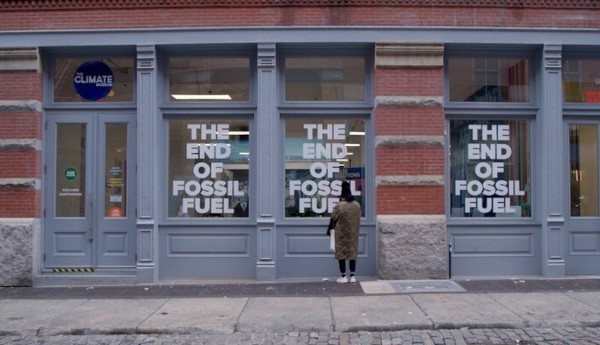 In February 2024, there was a small "Climate Museum" in Manhattan. I went there and joined a docent-led tour. The very first display was about redlining. For younger readers who may not know the term, redlining was a notorious form of racial discrimination in housing and mortgage lending that was became illegal over half a century ago. Huh??? Is this really the first thing a climate museum should bring up when explaining climate change? There was no meaningful discussion of climate science or engineering whatsoever. The concentration of CO₂ in the atmosphere was never even mentioned. A sign proclaimed "End Fossil Fuels," yet there was absolutely no discussion of what fossil fuels would be replaced with. There was no mention of:
But there were references to:
There wasn't a single thing in the museum that I could see that would persuade someone who had serious doubts about climate change. To the contrary, I kept thinking about what a conservative climate skeptic would make of the place. Such a visitor could easily walk out with every one of his prejudices about the climate movement completely confirmed: that the movement isn't really about atmospheric science, engineering, energy production, or finding practical ways to reduce CO₂ emissions, but is instead a vehicle for advancing an entirely separate left-wing social agenda. I wanted to (but didn't) grab the docent by the shoulders and yell in her: "Please get the heck out of the way! You
social justice warriors have nothing constructive
to offer this conversation!" |
| Conservative Climate Activists
Home Email the Organizer, |